
HEBRARIUM

Cannabis does not need
to enter fine dining as a stunt.
It can enter the conversation
as aroma chemistry.
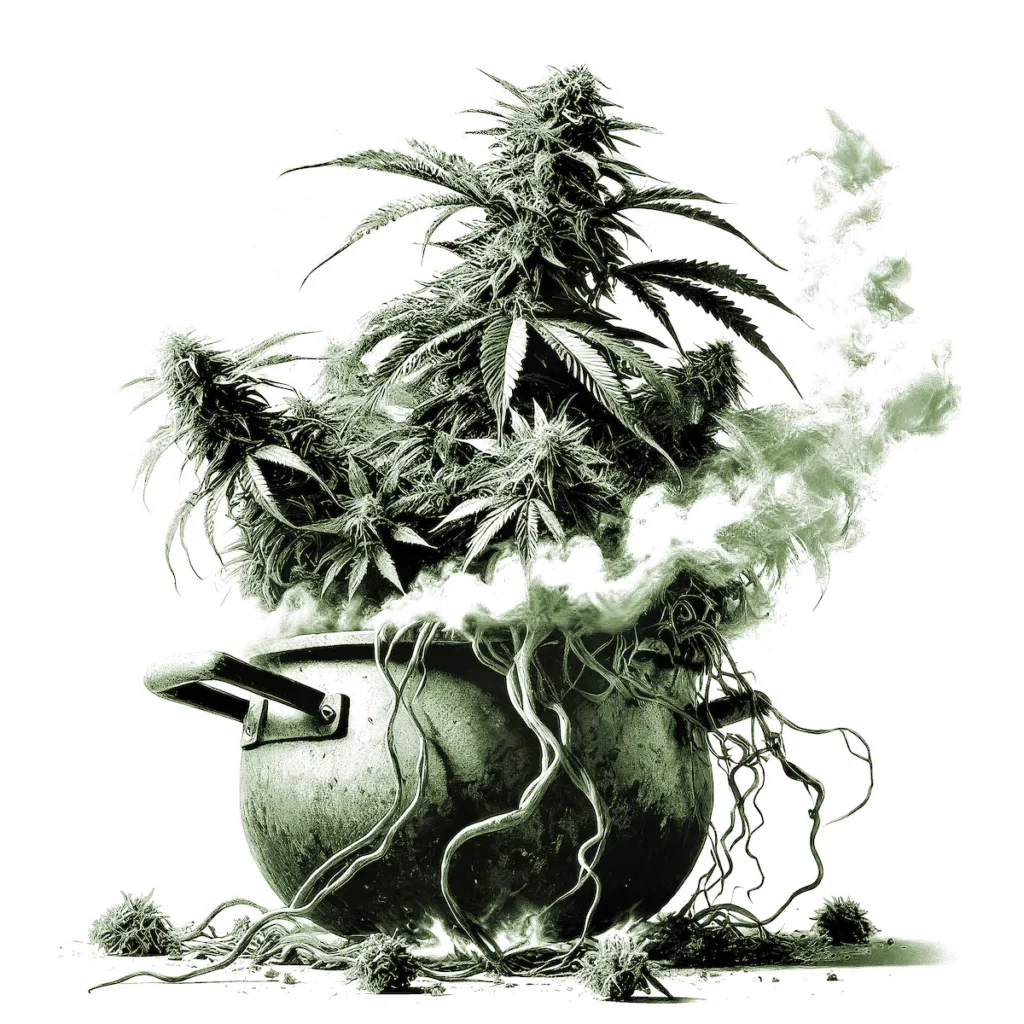
Cannabis cuisine has a problem of reputation.
For decades, the edible was treated as a punchline: a brownie, a mistake, a delayed effect, a story about someone taking too much and realising too late. That history is not imaginary. Poor dosing, weak labelling and casual preparation have made many cannabis foods less a culinary category than a public safety lesson.
But the plant is more interesting than the cliché.
Modern gastronomy gives us a better way to look at cannabis: not first as intoxication, but as aroma. Not as a shortcut to effect, but as a complex botanical ingredient whose volatile compounds, preparation method, temperature and dose all matter.
This is where the conversation becomes useful.
Heston Blumenthal’s work at The Fat Duck helped make British gastronomy think seriously about science, memory, perception and the senses. His public biography describes a cuisine built around curiosity, multisensory experience, memory and emotion, not simply flavour as a flat category. That does not make The Fat Duck a cannabis restaurant. It does make Blumenthal’s world useful for understanding why aroma matters.
The same is true of molecular gastronomy more broadly. Techniques such as sous-vide, emulsification, gels, foams and controlled temperature are not magic tricks. They are ways of controlling transformation. A 2025 review in Journal of Future Foods describes molecular gastronomy as the application of scientific principles to ingredients and culinary techniques, with attention to texture, flavour, appearance and multisensory experience.
Cannabis belongs in that discussion carefully.
The plant is rich in aromatic compounds, including terpenes also found in many familiar foods and herbs: limonene in citrus, linalool in lavender, pinene in pine and rosemary-like profiles, caryophyllene in black pepper and cloves, humulene in hops. These compounds do not make cannabis unique in nature. They make it chemically legible to the kitchen.
That distinction matters.
A chef does not need to say “cannabis is magic”. A chef can say: this plant carries aroma families that already exist in food. Citrus. Herb. Resin. Pepper. Earth. Flower. Wood. Fuel. Fruit. The culinary question becomes: what is the preparation trying to express, and what must be controlled?
Temperature is central. Cannabis cooking is not simply “adding weed to food”. Heat changes the plant. Decarboxylation converts acidic cannabinoids such as THCA into neutral cannabinoids such as THC, changing the likely effect. Infusion into fat, alcohol or glycerine changes extraction. Overheating can damage aroma. Under-measuring can make dosing irresponsible.
That is why the better cannabis kitchen is not a theatre of excess.
It is a kitchen of restraint.
In legal markets, some chefs have already moved beyond the old edible model. A 2014 interview with chef Sean Kelley described cannabis cooking through lab results, decarboxylation, terpene content, sous-vide infusion and the difference between raw and heated cannabis. The source is industry-level rather than academic, so it should not be treated as universal proof. But it shows the direction clearly: serious cannabis cuisine is about measurement, not bravado.
The most interesting version of cannabis gastronomy may not be the strongest one. It may be the most readable one.
A limonene-rich profile can suggest citrus, brightness and lift. Linalool can suggest floral softness. Caryophyllene can pull toward pepper, spice and warmth. Myrcene can move toward earth, musk, fruit or herbaceous depth. These are not rigid rules. They are aromatic clues.
And clues are not conclusions.
This is where cannabis marketing often overreaches. Terpenes are real. Terpene storytelling is often lazy. A menu that says “limonene for energy” or “myrcene for couch-lock” is usually doing more marketing than science. In the kitchen, the safer claim is sensory: aroma, flavour, pairing, volatility, extraction and balance.
The edible should not be a dare.
It should be a measured preparation, clearly labelled, legally compliant, age-restricted where required, and designed with the same seriousness expected from alcohol service, allergen control or food safety.
Cannabis cuisine without dose literacy is not gastronomy.
It is guesswork on a plate.
The future of cannabis in food may not be built by making everything psychoactive. It may be built by separating the questions:
A serious cannabis kitchen does not hide these questions.
It prints them on the menu.
Cannabis does not need fine dining to become respectable. But fine dining, food science and sensory research can help rescue cannabis cuisine from the brownie cliché. They remind us that the plant is not only an effect. It is also chemistry, aroma, preparation and responsibility.
The knowledge, not the marketing.
The moment cannabis moves from aroma to ingestion, the conversation changes. Flavour is no longer the only question. Dose, onset, duration, consent, storage and food safety enter the room.
SAFETY NOTE
The edible should not
be a dare.
Cannabis in food requires more caution than cannabis as aroma.
An edible does not behave like a smoked or vaporised product. The onset is usually slower, the duration can be longer, and the effect can feel stronger or more difficult to control once too much has been consumed. This is one reason accidental overconsumption is so common: people eat more before the first dose has fully appeared.
A responsible cannabis kitchen should never rely on guesswork. Products should be clearly labelled, legally compliant, age-restricted where required, and kept away from children, pets and anyone who has not knowingly consented to consume them.
The food itself also matters. A cannabis edible may carry ordinary food risks as well as cannabis-specific risks: allergens, alcohol, high sugar, chocolate, caffeine, or ingredients that are unsafe for animals, such as xylitol or raisins. The cannabis is not the only variable on the plate.
This is not an argument against cannabis food.
It is an argument against careless cannabis food.
A good edible is not the strongest one. It is the one whose dose, onset, ingredients and risks are understood before it is eaten.
Factual Note
The Heston Blumenthal link is useful for multisensory gastronomy, science, memory and flavour, not for a direct cannabis claim. The Fat Duck page supports that broader frame, not cannabis use.
The Green Dream interview is useful as an example of a chef discussing cannabis cooking, sous-vide infusion, decarboxylation and lab-tested products, but it is not a high-authority scientific source. Use it as industry evidence, not as universal proof.
The ScienceDirect article supports molecular gastronomy as a science-led culinary field using techniques such as sous-vide, emulsification and sensory design. It does not specifically validate cannabis cuisine.
What this article does not claim
It says something more modest and more useful: modern gastronomy gives cannabis culture a better vocabulary for aroma, temperature, extraction, dose and sensory design.
Join early.
Keep the archive open.
The VADEMECUM is becoming a living archive of guides, tools, notes and practical plant knowledge.
Free member access. Join early. Keep the archive open.
Join early.
Keep the
archive open.
The VADEMECUM is not just a book anymore. It is becoming a living archive of guides, tools, notes and practical plant knowledge.
Free member access. Join early. Keep the archive open.
The VADEMECUM is becoming a living archive of practical plant knowledge.
Free member access.