
HEBRARIUM

A prison grow is not liberation.
It is an institutional paradox.
Prohibition likes to imagine itself as a wall.
It separates legal from illegal, permitted from forbidden, controlled from uncontrolled. It builds fences, writes rules, searches cells, watches yards and names the plant as contraband. But sometimes the plant appears inside the very institution built to contain it.
That is where the story becomes more than a joke.
At HMP The Verne in Dorset, England, a prisoner was investigated after a plant believed to be cannabis was found in his cell. According to reporting at the time, he had tried to pass it off as a tomato plant and had even reportedly decorated it as a Christmas tree. The detail is absurd enough to survive without exaggeration. A plant in a cell. A tomato explanation. A Christmas disguise. The prison authorities suspected cannabis and sent the plant for testing.
The comedy is obvious.
The lesson is better.
A prison can identify a person, number a cell, search a room and test a prisoner. But the plant still required recognition. Someone had to look at it and know what they were seeing. Law can label cannabis as contraband. It cannot replace botanical literacy.
In Kassandra, Chalkidiki, the contradiction was larger and closer to the soil. Greek reports in July 2018 described 60 cannabis plants, around two metres tall, found inside the rural prison. The plants were reportedly cultivated by prisoners and connected to an automatic watering system.
This is not simply a funny Greek prison story. It is an institutional paradox. A rural prison is already a place where custody and agriculture meet. Work, fields, plants, irrigation and routine are part of the official environment. Under that cover, the forbidden plant could borrow the grammar of legitimate cultivation.
The system knew agriculture.
It did not read this agriculture in time.
At Fulham Correctional Centre in Victoria, Australia, the irony became almost educational. Prisoners taking part in a horticulture programme were reported to have planted 28 cannabis plants among the regular vegetables. The plants were found during a security check and were around half a metre high.
That case matters because the setting was not only a hiding place. It was a lesson. Horticulture was meant to teach structure, responsibility and rehabilitation. The prisoners used the same space to introduce a forbidden crop. The plant was not hidden in a tunnel or bunker. It was hidden in the category “garden”.
Prohibition often fails at the level of categories.
The answer depends on who is looking, what they know, and what the institution is willing to see.
These stories should not be romanticised. A prison grow is not liberation. It is not folk heroism. It may involve pressure, trade, punishment, debt, violence or institutional failure that does not appear in the amusing headline. The plant is visible; the social system around it may not be.
But they do reveal something important.
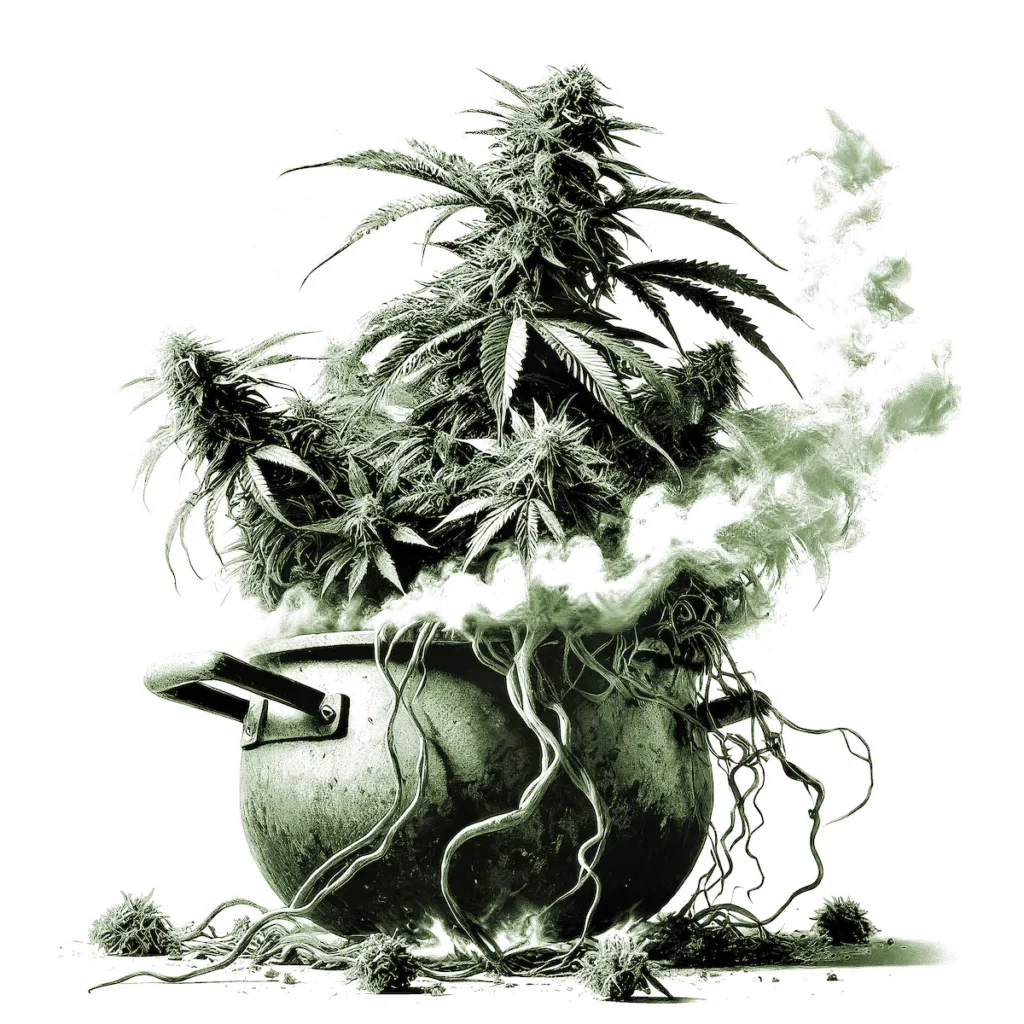
Prohibition does not remove cannabis from society. It teaches society to misread it, hide it, rename it, smuggle it, disguise it and sometimes cultivate it in plain sight. The more total the control claims to be, the more revealing the failure becomes when the plant appears inside the controlled space.
A cannabis plant in a prison cell is not important because it is large. It is important because it is impossible, and yet there it was.
The joke is allowed.
The conclusion still needs evidence.
Join early.
Keep the archive open.
The VADEMECUM is becoming a living archive of guides, tools, notes and practical plant knowledge.
Free member access. Join early. Keep the archive open.
Join early.
Keep the
archive open.
The VADEMECUM is not just a book anymore. It is becoming a living archive of guides, tools, notes and practical plant knowledge.
Free member access. Join early. Keep the archive open.
The VADEMECUM is becoming a living archive of practical plant knowledge.
Free member access.