
HEBRARIUM

A grower sees numbers.
pH 5.8… pH 6.4… EC 1.2… EC 2.1….
The plant does not see numbers. The plant experiences chemistry.
That difference is the beginning of serious cultivation.
A pH meter or EC meter is not a magic instrument. It is not a judge, a doctor or a recipe. It is a translator. It turns invisible chemical conditions into a reading the grower can act on. The danger begins when the reading becomes a ritual instead of a question.
A meter is not a number machine.
It is a translator between chemistry and decision.
The pH scale looks simple because the numbers are small.
5.0… 6.0… 7.0…
But the scale is logarithmic. Søren Peder Lauritz Sørensen introduced the pH scale in 1909 at the Carlsberg Laboratory as a practical way to express acidity and alkalinity, especially in biochemical reactions relevant to brewing. One pH unit represents a tenfold change in hydrogen ion activity. The scale looks linear. The chemistry is not.
That is the first hidden lesson.
A shift from pH 6 to pH 5 is not “one small unit”. It is roughly ten times more acidic in hydrogen ion terms. A shift from pH 7 to pH 5 is roughly one hundred times.
This does not mean every 0.2 drift is disaster. Plants and substrates have buffering capacity. Nutrient solutions are not pure mathematical abstractions. But it does mean pH deserves respect.
The grower who treats pH as a casual decimal
has not understood the scale.
Nutrients may be present and still become harder to use. Iron, manganese, phosphorus, calcium, magnesium and trace elements do not respond equally to pH. The question is not only “what did I add?” but “what chemical form is it in, and can the root use it?”
The plate can be full and the door can still be closed.
EC feels more direct than pH.
That is useful, but incomplete.
Electrical conductivity measures how well a solution conducts electricity. In cultivation, that usually means how many dissolved ions are present in irrigation water, feed solution, substrate extract or runoff. It is a practical indicator of soluble salts. It is not a complete nutritional analysis. Horticultural guidance uses EC as a way of monitoring nutrient levels in irrigation water, growing media and liquid feeds, but the reading remains a conductivity reading, not a full chemical profile.
EC does not tell you which ions are present.
This matters in cultivation because the plant does not want “EC”. It wants a balanced set of usable ions at the right concentration for its stage, environment and water movement.
EC is honest, but narrow.
It can warn you that soluble salts are building up. It can show that feed strength has changed. It can help compare input and runoff. But it cannot tell you whether the ratio is correct, whether sodium is crowding the root zone, whether calcium is being antagonised by potassium, or whether an organic input is still waiting for microbial processing.
That is the organic trap.
Many organic molecules do not behave like simple mineral salts in solution. Sugars, molasses, plant extracts, amino acids, humic substances and other carbon-based inputs may not raise EC in a simple, proportional way unless they contain or release charged ions. Some organic products do contain mineral ions and will affect EC. Others may carry nutritional value that the EC meter only sees later, after microbial breakdown or chemical transformation.
So the lesson is not “EC does not work with organics”.
The lesson is stricter:
EC measures conductivity, not fertility.
With mineral feed, conductivity often tracks the grower’s recipe fairly closely. With living soil or complex organic systems, EC becomes only one clue among many: water source, medium, biology, decomposition, pH buffer, plant response, smell, moisture, oxygen and time.
The grower measures a tank, a jug, a runoff tray or a substrate sample.
The root lives in the rhizosphere.
That word matters.
The rhizosphere is the narrow zone of soil or substrate influenced by the root. It is chemically and biologically active. Plants can alter rhizosphere pH through ion uptake, proton release, bicarbonate release, organic acids and interactions with microbes. This is not mystical. It is plant physiology.
When a plant takes up more cations such as K⁺, Ca²⁺, Mg²⁺ or NH₄⁺, it may release H⁺ to maintain charge balance, acidifying the rhizosphere. When it takes up more anions such as NO₃⁻, it may release OH⁻ or HCO₃⁻ equivalents, tending to raise pH around the root. The exact response depends on nutrient form, species, medium, microbial activity and environment.
This is one of the most important hidden lessons for growers:
The root is not sitting in the pH you measured.
It is negotiating it.
That does not make measurement useless.
It makes measurement more interesting.
But none of them is identical to the living chemistry at the root surface.
A serious grower does not worship one reading.
A serious grower triangulates.
EC is temperature-sensitive.
Warm solutions conduct more easily than cold ones. That is why good meters use temperature compensation and why serious measurements should be made with clean, calibrated instruments. A reading is not just a reading; it is a reading under conditions.
pH meters have their own temperature story. The glass electrode produces a voltage response that changes with temperature, and modern pH meters use the Nernst equation to convert electrode potential into pH. Thermo Fisher’s pH handbook notes that pH meters detect the pH electrode signal, reference signal and temperature signal, then use these values to calculate pH using the Nernst equation.
This is where Walther Nernst enters the grow room.
Not as a name on a wall,
but as the mathematical reason the meter can speak.
A pH probe is not a spoon.
It is a fragile electrochemical system.
The glass membrane, reference junction, storage solution and calibration buffers matter. A dry, dirty or old pH probe can lie. A probe stored incorrectly can drift. Calibration is not bureaucracy; it is how the grower asks the instrument whether it still remembers how to speak.
EC probes are generally more robust, but they also need cleaning, correct calibration solution and awareness of contamination, temperature and scale deposits.
This is one of the most underrated lessons in cultivation:
Before you correct the plant, check the instrument.
Many grower problems begin with a false reading followed by a confident correction.
The plant pays for the grower’s certainty.
A good meter does not replace judgement.
But the best meter still needs a literate grower.
That is the real message:
The instrument gives the reading.
The grower gives it meaning.
Sørensen gave growers the language of acidity.
Working at the Carlsberg Laboratory, he introduced pH in 1909 as a way to express hydrogen ion concentration and understand biochemical reactions. It is one of the beautiful accidents of applied science: a tool refined in a brewing laboratory became essential to chemistry, biology, medicine, water testing and cultivation.
Better lesson:
The grow room inherited a number born in fermentation science.
Arrhenius gave growers the ionic world.
His theory of electrolytic dissociation explained that salts, acids and bases can split into charged ions in water. The Nobel Prize summary describes his work on how electrical current is conducted in chemical solutions and his proposal that dissolved rock salt separates into positively and negatively charged particles. He received the 1903 Nobel Prize in Chemistry for this work.
Every EC reading belongs to that world.
The meter works because dissolved ions carry charge. The nutrient bottle is not just “food”. In water, it becomes an ionic landscape.
Better lesson:
When you read EC,
you are reading Arrhenius in the reservoir.
Nernst gave growers the electrochemical bridge.
The Nernst equation links electrode potential to chemical activity. It is central to how pH electrodes and other ion-selective measurements translate chemistry into voltage and voltage into a number. A pH meter measures millivolts, then calculates pH. The display is simple because the electrochemistry is not.
Better lesson:
The pH number on the screen
is a voltage translated into trust.
| Claim | A pH drift of one unit is a small change. |
| Verdict | False. |
| Better lesson | One pH unit represents a tenfold change in hydrogen ion activity. |
| Claim | EC tells you how much food the plant has. |
| Verdict | Misleading. |
| Better lesson | EC indicates dissolved ionic concentration. It does not identify the nutrient profile or biological availability. |
| Claim | Organic nutrients do not affect EC. |
| Verdict | Too broad. |
| Better lesson | EC sees charged ions. Some organic inputs are poorly represented by EC; others contain minerals or charged compounds and will affect the reading. |
| Claim | Runoff pH is the root pH. |
| Verdict | Too simple. |
| Better lesson | Runoff is a useful clue, but the rhizosphere is dynamic and may differ from bulk solution or runoff. |
| Claim | A calibrated meter is optional. |
| Verdict | Dangerous. |
| Better lesson | Uncalibrated measurement can be worse than no measurement because it creates false confidence. |
pH tells you where the water is.
Alkalinity tells you how hard it will fight to stay there.
Factual Note
At the Jirzankal Cemetery in the eastern Pamirs, dated around 500 BCE, researchers found cannabinoid residues in wooden braziers and on burned stones.
The evidence indicates that cannabis plants were burned during mortuary ceremonies, making this one of the earliest directly dated and scientifically verified examples of ritual cannabis smoking.
 Jirzankal Cemetery
Eastern Pamirs, western China
c. 500 BCE
A high-altitude burial site where wooden braziers and heated stones preserved chemical evidence of burned cannabis.
The context suggests ritual or religious use during funerary ceremonies.
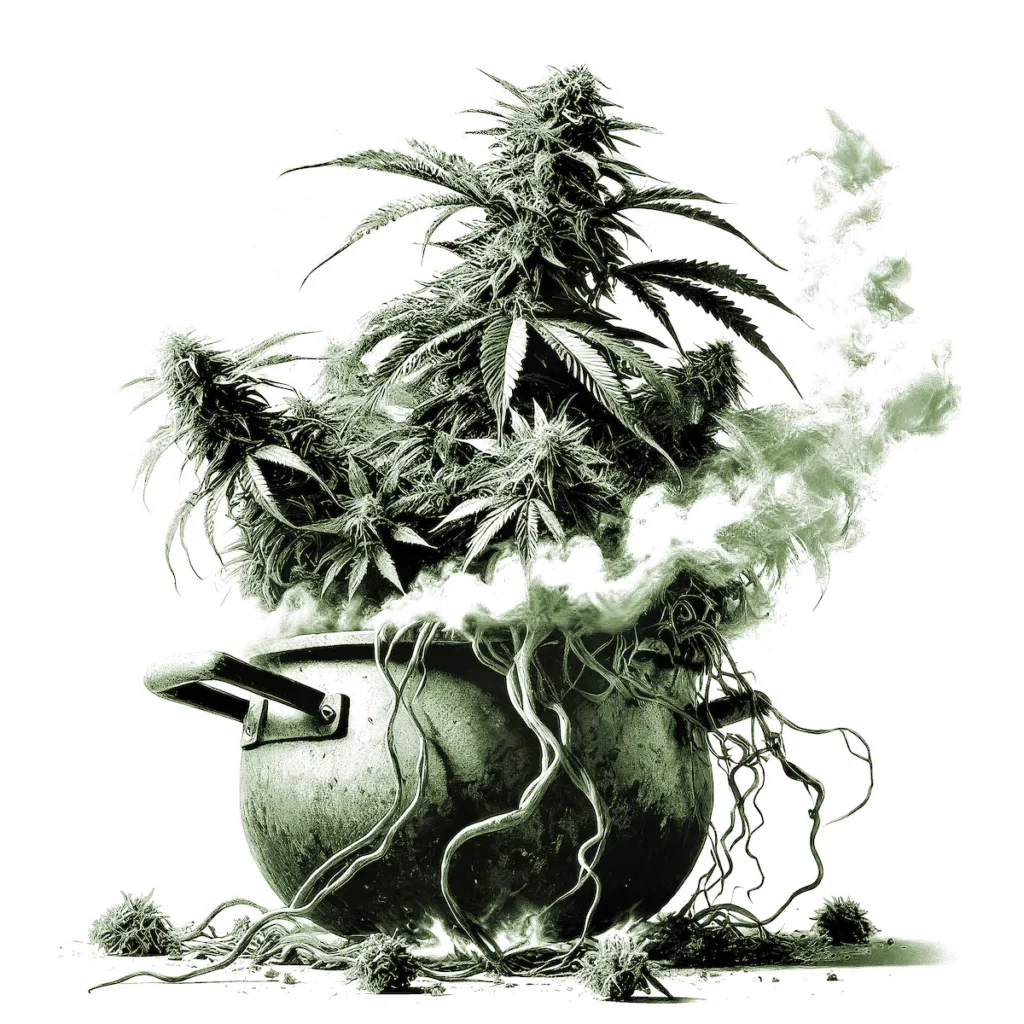
Join early.
Keep the archive open.
The VADEMECUM is becoming a living archive of guides, tools, notes and practical plant knowledge.
Free member access. Join early. Keep the archive open.
Join early.
Keep the
archive open.
The VADEMECUM is not just a book anymore. It is becoming a living archive of guides, tools, notes and practical plant knowledge.
Free member access. Join early. Keep the archive open.
The VADEMECUM is becoming a living archive of practical plant knowledge.
Free member access.