
HEBRARIUM

Cannabis and love make an easy story.
Too easy.
The temptation is obvious: turn the plant into a love potion.
That is exactly where serious cannabis writing must slow down.
Cannabis can appear near intimacy, but it should not be made responsible for love. It can change mood, perception, anxiety, appetite, pain, attention, inhibition or bodily comfort. It can also confuse, dull, overwhelm, dissociate, impair consent or make memory unreliable. A story that begins with tenderness can become dishonest if the plant is treated as magic.
The better question is not:
Did cannabis create love?
The better question is:
What did cannabis reveal, relieve or risk
in the relationship?
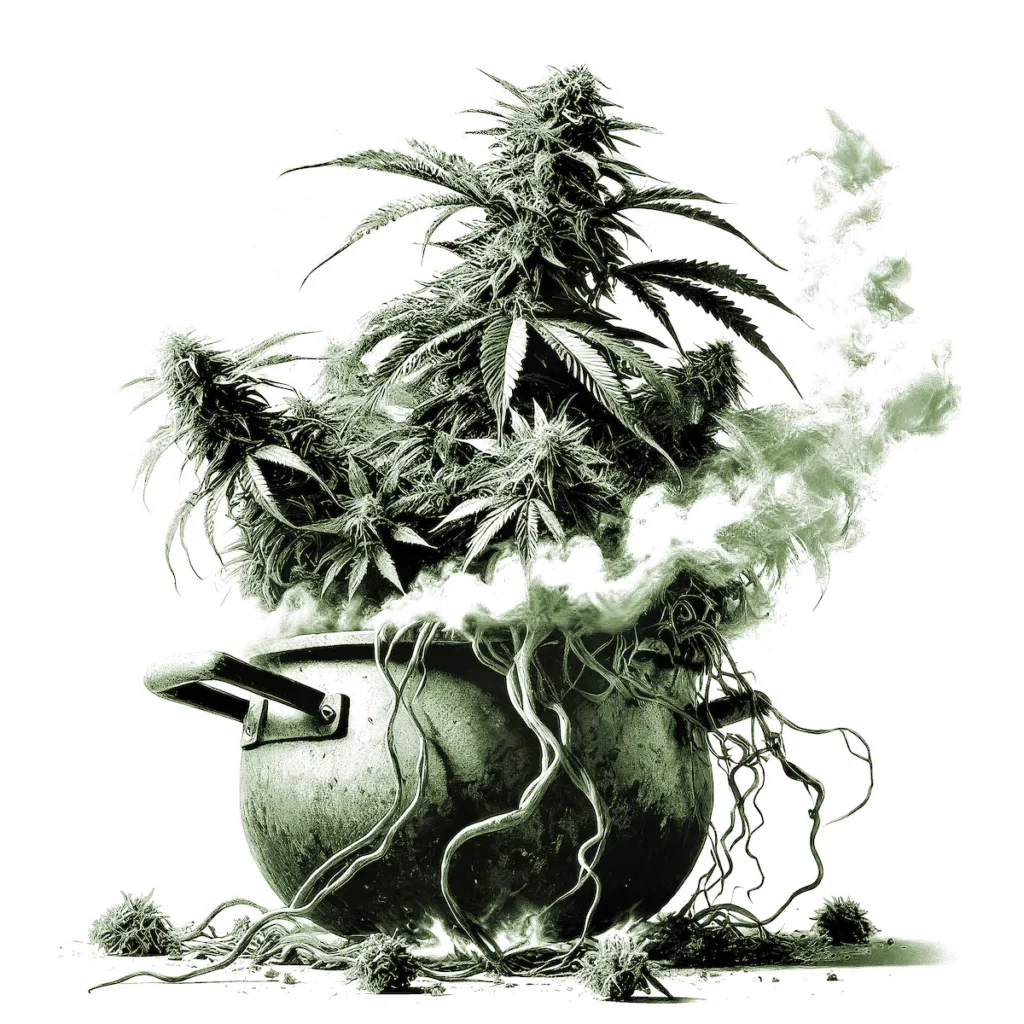
The plant was not buried.
It was burned into the ritual.
Louisa May Alcott’s Perilous Play is one of the rare literary cases where hashish is not background decoration. It is part of the plot.
Published in 1869, the story places young people of polite society in a situation of boredom, curiosity and emotional restraint. Hashish bonbons enter as an experiment. The drug does not simply produce pleasure. It disturbs the social surface. It alters behaviour, loosens control, creates danger and pushes hidden feeling into the open.
That is why the story matters.
Not because Alcott proves cannabis is romantic.
Not because hashish is a “truth serum of love”.
But because she understood something subtle:
Altered states can expose the theatre
of polite life.
People who cannot speak honestly in the drawing room may speak differently under pressure, fear or intoxication. That does not make the intoxication noble. It makes the social world legible.
In Perilous Play, cannabis is a literary catalyst.
The love was not manufactured by hashish.
The masks were weakened by it.
That is a stronger reading.
The plant was not buried.
It was burned into the ritual.
The deeper cannabis love story may not be romance at all.
It may be care.
These are not “love potion” stories.
They are stories about what people do when suffering enters the room and the official answers are not enough.
Here, cannabis is not erotic. It is practical, desperate, tender and sometimes risky. The emotional force is real. But the responsibility remains: product quality, dose, legality, medical supervision, interactions, consent and evidence.
Love does not make a treatment safe.
But love may explain why people search
before the system is ready.
Any article about cannabis and intimacy needs one clear boundary.
Altered states complicate consent.
That does not mean cannabis and intimacy cannot coexist. It means no serious educational project should romanticise intoxication as a shortcut to emotional truth, sexuality or surrender.
If cannabis is present in an intimate setting,
the ethical questions matter:
A loosened inhibition is not automatically honesty.
Sometimes it is vulnerability without protection.
This is where the “love potion” myth
must stop.
No plant can do
the hard work of love for us.
The false grail is the fantasy that cannabis can bypass the hard parts of love.
No plant can do that work for us.
The relationship remains human.
And humans remain responsible.
| Claim | Cannabis creates romantic truth. |
| Verdict | Myth / literary temptation. |
| Better lesson | Cannabis may alter inhibition, mood or perception, but love and truth remain human responsibilities. |
| Claim | Perilous Play is a cannabis love story. |
| Verdict | Enters with caution. |
| Better lesson | It is a story where hashish acts as a catalyst for danger, emotional exposure and social unmasking. |
| Claim | Sufi cannabis lovers used the plant for divine union. |
| Verdict | Cut unless tied to a specific source. |
| Better lesson | Do not insert cannabis into mystical love traditions without textual evidence. |
| Claim | Caregiving stories prove cannabis is good. |
| Verdict | Too simple. |
| Better lesson | They prove need, suffering and love. Efficacy and safety still require evidence. |
Factual Note
Louisa May Alcott’s Perilous Play is the strongest example here because the hashish bonbons are actually in the text and drive the action. Use it as literature, not as medical or moral proof.
The Sisters of the Valley can be discussed as a modern cultural example of cannabis, care, women’s labour and healing language, but not as a specific romantic sacrifice story unless a reliable source supports that individual account.
The Sufi example should stay out unless we locate a specific primary or scholarly source. Otherwise it becomes exactly the kind of ritual-romantic cannabis insertion LIBERA HERBA avoids.
Join early.
Keep the archive open.
The VADEMECUM is becoming a living archive of guides, tools, notes and practical plant knowledge.
Free member access. Join early. Keep the archive open.
Join early.
Keep the
archive open.
The VADEMECUM is not just a book anymore. It is becoming a living archive of guides, tools, notes and practical plant knowledge.
Free member access. Join early. Keep the archive open.
The VADEMECUM is becoming a living archive of practical plant knowledge.
Free member access.