
HEBRARIUM

A naive question
can open a serious door.
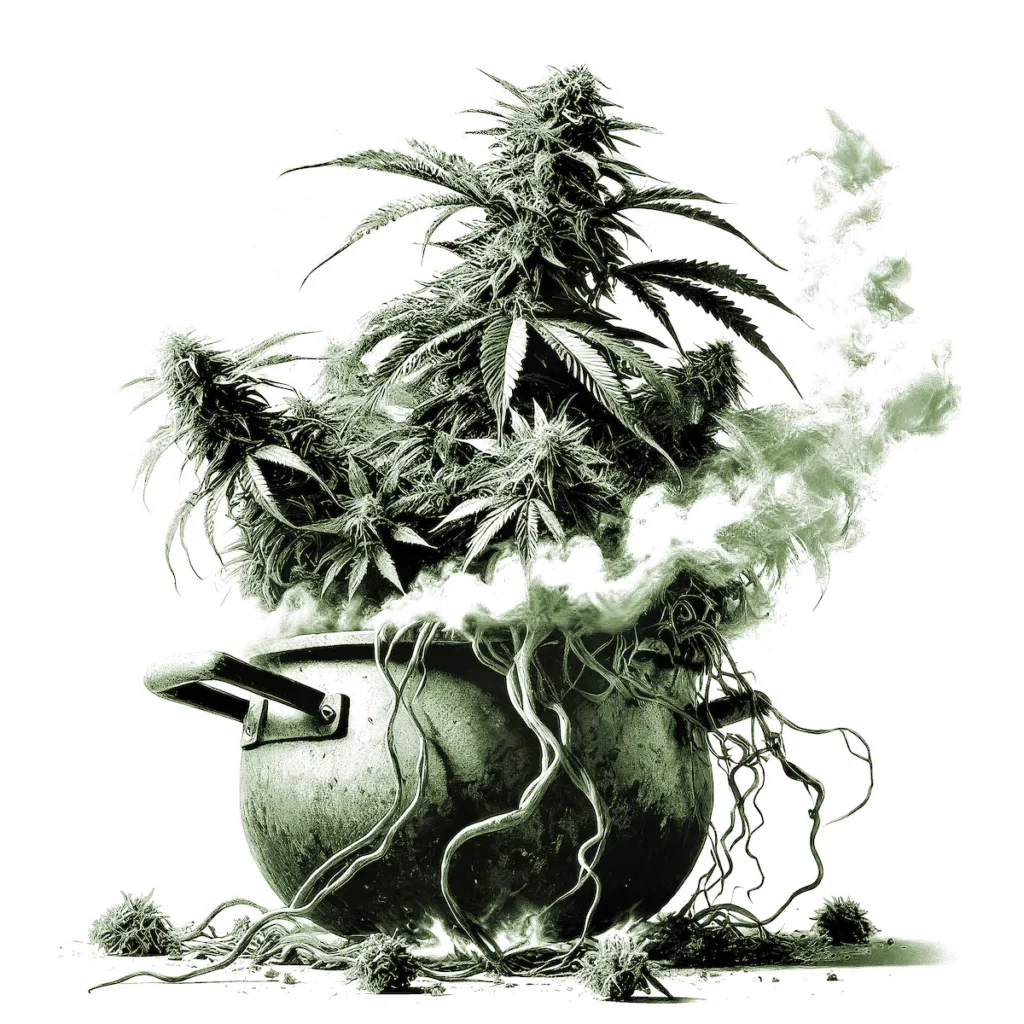
Cannabis is a plant.
That should be obvious. It should also be protected. When cannabis writing forgets the plant and turns it into a cosmic symbol, a miracle material, a political mascot or a secret code for everything, knowledge becomes noise.
But imagination can still be useful.
What if cannabis were not a plant?
What would it be?
Not because the answer is literally true.
Because the comparison forces us to look again
at what the plant actually does.
It would not be a miracle material.
It would be a material system.
The stem can provide bast fibre and hurd. The seed can provide oil and food. The flower produces volatile aromatic compounds and cannabinoids. The biomass can become pulp, composite filler, activated carbon or building material. This does not make cannabis unique in every category. It makes it unusually broad as an agricultural raw material.
That is the useful point.
A miracle material solves everything.
A serious material solves specific problems.
Hemp fibre has been studied and used in composites, textiles, paper, insulation, bioplastics and construction materials. Its value is not that it replaces every material. Its value is that it can sometimes replace part of a material system with something lighter, renewable or lower-impact, depending on processing, performance and scale.
Better lesson:
Cannabis is not one material.
It is a plant that can enter many material chains.
A stem is not a battery.
But under the right process,
it can become part of one.
It would not be a “quantum battery”.
That phrase should stay out.
But there is a real energy-storage story worth keeping. Researchers have produced interconnected carbon nanosheets from hemp bast fibre and tested them as electrode materials for supercapacitors. The 2013 ACS Nano paper reported high-surface-area, partially graphitic carbon nanosheets derived from hemp, with promising performance for ultrafast supercapacitors.
That is not the same as saying “hemp batteries will power cars”. It is better than that: it is a real example of plant waste or low-value biomass being transformed into high-value carbon material.
Better lesson:
The interesting claim is not that hemp is a battery.
It is that hemp fibre can be converted into carbon
structures useful for energy-storage research.
The printer does not care about the myth.
It cares about the material.
This one is real, but modest.
Hemp-filled PLA filaments exist, and research continues on hemp fibre or hemp hurd reinforced PLA composites for 3D printing. A 2024 study reported hemp hurd fibre-reinforced PLA filaments for fused deposition modelling, including recyclability over multiple cycles; other recent work has tested hemp fibre-reinforced PLA for sustainable 3D printing applications.
But again, no hype.
Hemp filament does not make every print stronger. Fibre content, particle size, processing, nozzle size, bonding with the polymer, moisture and print settings all matter. Many commercial hemp filaments are aesthetic or sustainability-oriented rather than structural engineering materials.
Better lesson:
Hemp in 3D printing is not magic plastic.
It is a biofiller/reinforcement question.
A plane is not persuaded by sustainability language.
It flies only if the material passes the test.
This one needs the most caution.
There are public claims from Hempearth about developing an aircraft made largely from hemp composites and powered by hemp biofuel. But the strongest sources available are company statements and media reports, not independent aviation certification or peer-reviewed aerospace validation.
So we do not write:
“A hemp aircraft has proved hemp is 10 times stronger than steel.”
That line is marketing unless it is tied to a precise material test: what composite, what direction of load, what density, what tensile strength, compared to what steel, under what standard?
We can write:
A proposed hemp-composite aircraft is a useful speculative design story, not yet strong proof of an aerospace revolution.
Better lesson:
Hemp composites may be interesting for lightweight design, but aviation is not a place for slogans.
It is a place for certification, testing and failure analysis.
You cannot print a crop.
You have to grow it, cut it, process it
and move it.
This is useful only as metaphor.
Hemp was historically valuable, and some colonial laws encouraged or required hemp cultivation. There are claims that hemp could be used to pay taxes in some colonial American contexts, but this needs precise sourcing before being used strongly.
As a metaphor, though, it works:
Cannabis is not like money because it is mystical. It is like money because value requires labour, trust, storage, exchange and use. A crop is never just a crop when a society depends on what it can become: rope, sail, cloth, paper, oil, food, medicine, tax, law or contraband.
Better lesson:
The value of hemp was never only symbolic.
It came from work and use.
A metaphor
is not a mechanism.
Here we need the biggest stylistic brake.
The fractal leaf idea is attractive, but botanically weak if stated literally. Serrated leaves are not the same thing as a Mandelbrot set. The entourage effect should also not be described as proven non-linear magic. It remains a research question and often a marketing overclaim.
But the mathematical metaphor can still teach something.
Cannabis is not a single-variable plant. Change the genetics, light, medium, nutrition, harvest time, drying method, storage or extraction, and the outcome changes. That does not make the plant a cosmic equation. It makes it a biological system with interacting variables.
Better lesson:
Cannabis is not simple
because living systems are not simple.
What cannabis can teach
when the question is allowed to be naive.
What if cannabis were not a plant?
The question is absurd. That is why it works.
Cannabis is a plant before it is anything else: a living organism with roots, leaves, flowers, fibres, seeds, chemistry, limits and needs. When writing forgets that, the plant becomes whatever the storyteller wants it to be: miracle material, sacred code, cosmic medicine, industrial saviour, political symbol.
LIBERA HERBA does not need that.
But imagination can still be useful if it stays honest.
A naive question can make a familiar plant unfamiliar again. It can force us to ask what cannabis actually does, what it does not do, and where the evidence ends.
If cannabis were a material, it would not be magic. It would be a material system. Fibre, hurd, seed, oil, flower, biomass, resin, aroma: different parts of the plant enter different chains of use. The value is not one miracle. The value is versatility.
If cannabis were a battery, the literal answer would be no. But hemp bast fibre has been converted into carbon nanosheets for supercapacitor research. That is a real technological trace: not the plant as electricity, but plant structure transformed into engineered carbon.
If cannabis were a printer’s material, the answer would already be partly yes. Hemp-reinforced PLA and hemp hurd composite filaments are being studied and sold for 3D printing. The serious question is not whether the word “hemp” sounds sustainable. It is whether the composite prints well, holds strength, manages moisture, survives use and can be recycled or biodegraded responsibly.
If cannabis were an aircraft, the answer would need a test lab before a headline. Hemp-composite aircraft claims exist, but aviation is not validated by enthusiasm. It needs material standards, certification, fatigue testing, fire behaviour, impact performance and independent review.
If cannabis were mathematics, it would not be a fractal spell. It would be a system of interacting variables: genetics, environment, nutrition, microbiology, water, light, temperature, harvest, drying, storage and use. Change one variable and the plant may answer somewhere else.
That is the point of the exercise.
The question may be playful.
The answer still needs evidence.
Cannabis does not become more interesting when we pretend it is everything. It becomes more interesting when we see how many real doors one plant can open: agriculture, chemistry, fibre, food, medicine, architecture, energy research, printing, law, culture and memory.
The plant is enough.
The imagination is allowed.
The conclusion still needs a source.
Join early.
Keep the archive open.
The VADEMECUM is becoming a living archive of guides, tools, notes and practical plant knowledge.
Free member access. Join early. Keep the archive open.
Join early.
Keep the
archive open.
The VADEMECUM is not just a book anymore. It is becoming a living archive of guides, tools, notes and practical plant knowledge.
Free member access. Join early. Keep the archive open.
The VADEMECUM is becoming a living archive of practical plant knowledge.
Free member access.