
HEBRARIUM

The plant did not give science all the answers.
It gave science better questions.
Cannabis did not rewrite neuroscience by itself.
Cannabinoid research opened doors that neuroscience had to walk through.
That distinction matters.
The plant had been used for centuries before modern science could explain its effects. People knew fibre, seed, resin, intoxication, appetite, sleep, pain relief, laughter, anxiety, calm and confusion long before they knew receptors, ligands or retrograde signalling.
Experience came first.
Explanation came later.
The modern scientific turn began when chemistry gave the plant a handle. In 1964, Raphael Mechoulam and Yehiel Gaoni isolated and described the structure of Δ9-THC, the main psychoactive constituent of cannabis. Once the molecule was known, the next question became unavoidable:
where does it act?
That question led to one of the major discoveries in modern neurobiology.
In 1988, William Devane, Allyn Howlett and colleagues reported the determination and characterisation of a cannabinoid receptor in rat brain. This receptor, later known as CB1, helped establish that THC was not acting vaguely or magically. It had a biological target.
That discovery changed the conversation. If the body has receptors for cannabinoids, then the obvious question follows:
what does the body make for those receptors?
The answer led to the endocannabinoid system: endogenous ligands, receptors and enzymes involved in regulating many physiological processes. This did not make cannabis a miracle. It made cannabis a doorway into a signalling system that already belonged to the body.
That is the educational correction.
The body is not “designed for cannabis”.
The plant helped reveal a system the body already uses.
CB1 receptors are especially important in the nervous system and are often described as among the most abundant G-protein-coupled receptors in the mammalian brain. That abundance helps explain why cannabinoids can affect so many functions: movement, memory, appetite, pain, mood, reward, stress and synaptic regulation. But abundance is not permission for exaggeration. A receptor being widespread does not make every cannabis claim true.
It makes the system important.
The second major door was retrograde signalling. For a long time, the simplest teaching model of synaptic communication ran in one direction: a presynaptic neuron releases neurotransmitter, and a postsynaptic neuron receives the signal.
Endocannabinoids complicated that picture.
They can be produced by the postsynaptic neuron and travel backwards across the synapse to act on presynaptic CB1 receptors, reducing neurotransmitter release. Reviews describe retrograde signalling as the principal mode by which endocannabinoids mediate forms of synaptic plasticity at both excitatory and inhibitory synapses.
This is one of the most beautiful scientific traces of cannabis.
The plant did not simply reveal intoxication.
It helped reveal feedback.
A cell can say back:
That does not mean endocannabinoids are a simple “calm down” button. Biology is more complex than slogans. But the thermostat metaphor is useful if handled carefully: the endocannabinoid system participates in regulation, not magic.
The third door is chemistry — and here LIBERA HERBA must be especially disciplined.
Cannabis is chemically complex. It contains cannabinoids, terpenes, flavonoids and many other constituents. This complexity has led to the popular idea of the entourage effect: the possibility that cannabis compounds may interact in ways that modify effect, tolerability or therapeutic value.
The idea is interesting.
It is not settled.
Recent reviews continue to investigate possible complementary or synergistic effects in cannabis medicinal products. But other research has challenged common terpene claims, finding no clear interaction of selected cannabis terpenoids at cannabinoid receptors under tested conditions.
That is exactly why the entourage effect belongs in education, not marketing.
It should not be used as a magic phrase. It should not be printed on a label as if it solves the science. It should not be treated as proof that whole-plant products are automatically better for every person and every condition.
The better line is this:
The cannabis phytochemical matrix
is a real research field.
The entourage effect is a hypothesis to test.
For LIBERA HERBA, these three scientific chapters matter because they move cannabis away from both panic and folklore.
Instead:
This is how cannabis becomes readable.
The plant did not give science all the answers.
It gave science better questions.
And that may be its greatest scientific contribution.
Dachau, drugs and the discipline
of not borrowing horror.
Cannabis history must be careful around atrocity.
The fact that a story is shocking does not make it useful. The fact that drugs were used in abusive experiments does not automatically make those experiments part of cannabis history.
At Dachau, Nazi doctors conducted human experiments on prisoners without consent. The wider record of Nazi medical experimentation is clear: prisoners were subjected to painful, coercive and often deadly procedures in conditions that modern science rejects entirely.
One specific thread concerns the Nazi search for interrogation drugs. Sources describe mescaline experiments at Dachau connected to the search for a “truth drug”. This belongs to the history of coercive pharmacology, interrogation and pseudoscience. It should not be casually converted into a cannabis story unless the cannabis evidence is actually there.
The Dachau “herb garden” is another dark trace. Under the SS, prisoners were forced to build and work in a large experimental herb plantation with greenhouses, research buildings and fields. Himmler’s aim was to reduce dependence on imported medicines and herbs. The language was agricultural. The reality was forced labour.
This is where LIBERA HERBA draws a line.
Cannabis history does not need to borrow horror in order to become serious. If cannabis appears in the record, it can be discussed. If it does not, the story must remain where the evidence places it: in the history of Nazi medical abuse, forced labour and the search for chemical control.
The lesson is not that “the Nazis studied cannabis”.
The lesson is stricter: knowledge without consent
is not knowledge worth celebrating.
Before the receptor, the molecule.
Before the claim, the chemistry.
The isolation and structural description of THC in 1964 gave researchers a defined molecule to study.
Once the molecule was known, the receptor question became possible.
THC was not acting vaguely.
It had a target.
The 1988 characterisation of a cannabinoid receptor in brain tissue helped establish a biological target for THC.
CB1 later became central to understanding the endocannabinoid system.
The plant helped reveal a system
the body already uses.
The discovery of cannabinoid receptors led to the search for endogenous ligands.
That changed the meaning of cannabis research: the plant was no longer only a foreign drug, but a tool for revealing a native signalling system.
The plant did not simply reveal intoxication.
It helped reveal feedback.
Endocannabinoids can travel backwards across the synapse, from postsynaptic neuron to presynaptic terminal, regulating neurotransmitter release.
This made cannabis research part of a larger story about feedback, plasticity and neural balance.
The entourage effect belongs in education,
not marketing.
The entourage effect is a research question, not a marketing spell.
Cannabis compounds may interact in meaningful ways, but the evidence is not strong enough to turn every whole-plant claim into settled science.
Factual Note
Modern cannabinoid science took a major step in 1964 when Gaoni and Mechoulam isolated and described the structure of THC. In 1988, Devane, Howlett and colleagues characterised a cannabinoid receptor in brain tissue, later known as CB1. The discovery of cannabinoid receptors led to the identification of endogenous cannabinoids and the wider endocannabinoid system.
Endocannabinoids often act as retrograde messengers, travelling from postsynaptic cells back to presynaptic terminals to regulate neurotransmitter release. The entourage effect remains an active and contested research area: possible phytochemical interactions are scientifically interesting, but broad claims of predictable synergy should be treated cautiously.
 The science the plant opened
THC · CB1 · endocannabinoid system · retrograde signalling · entourage effect
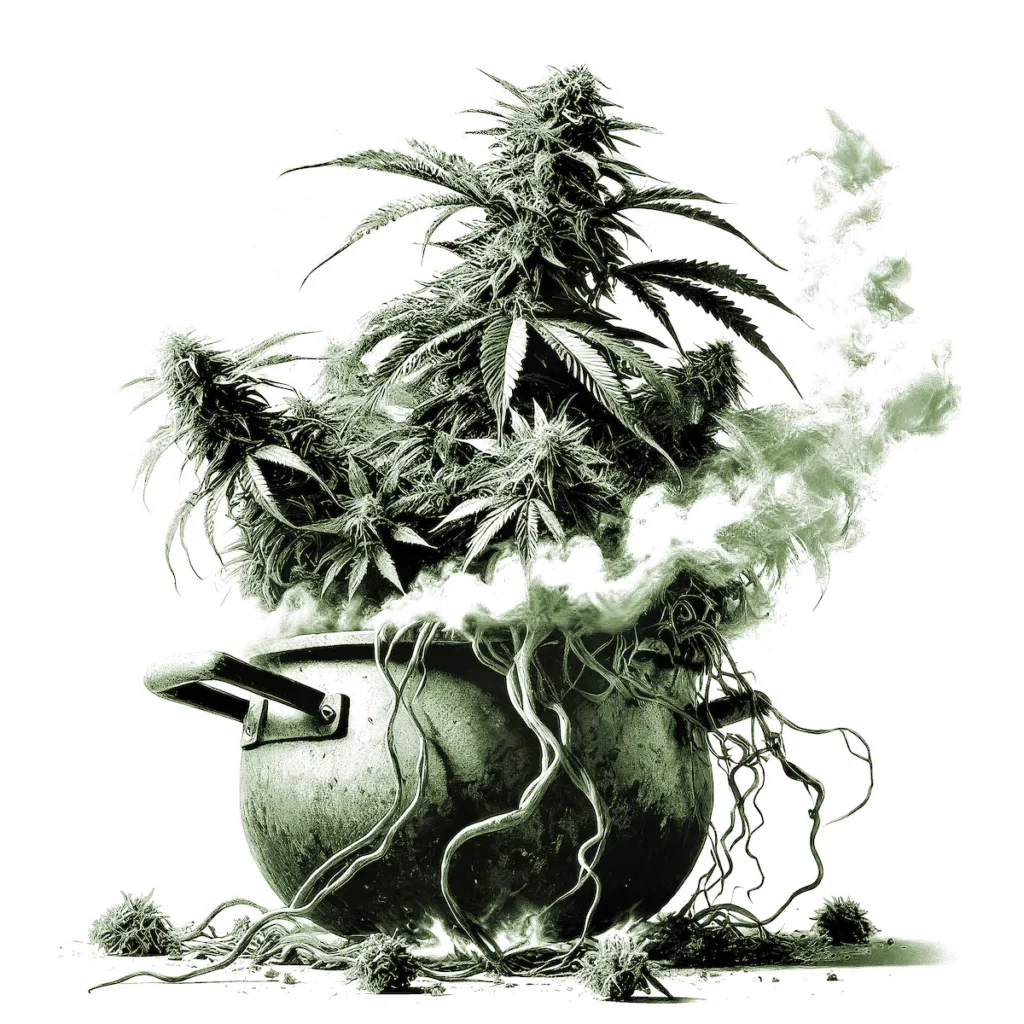
A scientific trace of cannabis through the discoveries it helped provoke: receptors, endogenous signalling, synaptic feedback and the difficult chemistry of whole-plant interaction.
Join early.
Keep the archive open.
The VADEMECUM is becoming a living archive of guides, tools, notes and practical plant knowledge.
Free member access. Join early. Keep the archive open.
Join early.
Keep the
archive open.
The VADEMECUM is not just a book anymore. It is becoming a living archive of guides, tools, notes and practical plant knowledge.
Free member access. Join early. Keep the archive open.
The VADEMECUM is becoming a living archive of practical plant knowledge.
Free member access.